Money
Discount Calculator
What you really pay with two discounts in a row
With this discount calculator you see what you pay after a markdown, how much you save and the real discount when two stack up, such as a sale price plus a coupon at checkout.
The key idea
20% off plus 10% off is not 30%: it is 28%
Stacked discounts apply one after the other, the second one on the already reduced price. A $150 pair of sneakers at 20% off and then 10% off ends up at $108, which is 28% less, not 30%. The gap grows as the discounts get bigger.
How it is calculated
Sale price = Price × (1 − d₁ / 100) × (1 − d₂ / 100)
Each discount applies to the price left after the previous one. That is why two discounts in a row add up to less than their plain sum.
Real discount = 1 − (1 − d₁ / 100) × (1 − d₂ / 100)
To find the price before a discount, undo it by dividing, not by adding: original price = sale price / (1 − discount / 100).
Worked example
A $150 pair of sneakers at 20% off, with an extra 10% off at checkout:
150 × 0.80 × 0.90 = $108 · you save $42 · real discount of 28%
If you pay $90 for something marked 25% off, its original price was 90 / 0.75 = $120. Adding 25% to $90 would give $112.50, which is wrong.
Typical cases
Percent off chart: sale prices
The sale price of common prices at the most common discounts. For a stacked discount (like 20% plus an extra 10%), use the calculator above: it is not 30% off.
| Price | 10% off | 20% off | 25% off | 30% off | 40% off | 50% off |
|---|---|---|---|---|---|---|
| $20 | $18.00 | $16.00 | $15.00 | $14.00 | $12.00 | $10.00 |
| $50 | $45.00 | $40.00 | $37.50 | $35.00 | $30.00 | $25.00 |
| $100 | $90.00 | $80.00 | $75.00 | $70.00 | $60.00 | $50.00 |
| $200 | $180.00 | $160.00 | $150.00 | $140.00 | $120.00 | $100.00 |
| $500 | $450.00 | $400.00 | $375.00 | $350.00 | $300.00 | $250.00 |
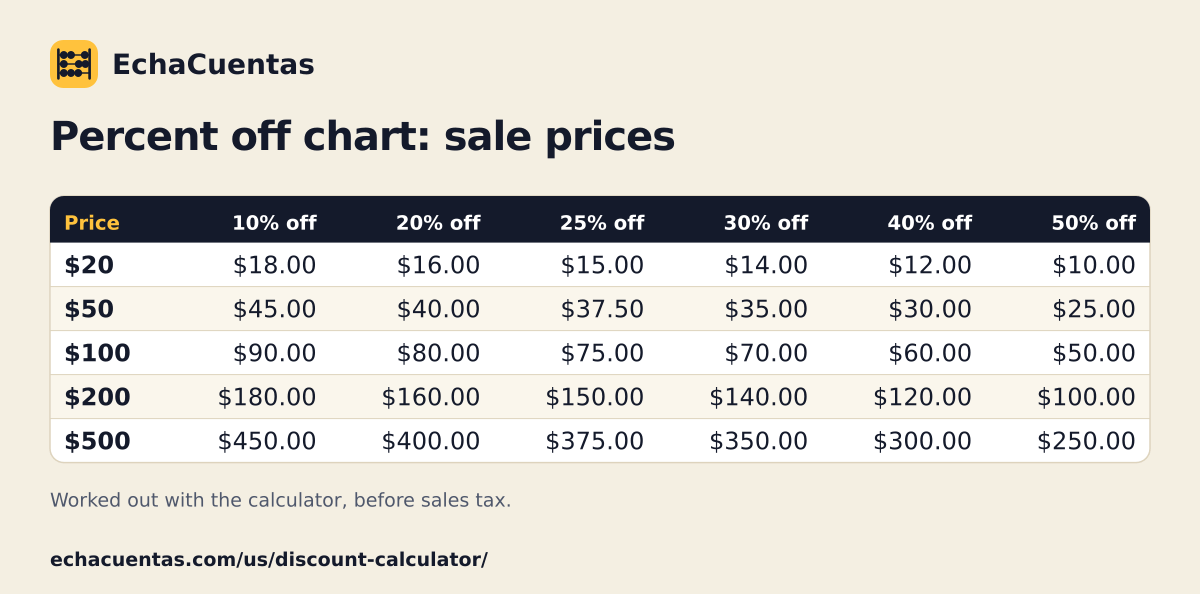 Save or share this table as an image
Common questions
Frequently asked questions
How do I calculate a discount?
Multiply the price by (1 − discount / 100): $150 at 20% off is 150 × 0.8 = $120. What you save is the difference, $30.
Are 20% and 10% discounts the same as 30% off?
No, together they are 28% off. The second discount applies to the already reduced price, so it always adds up to less than the plain sum of the two.
How do I find the original price of a sale item?
Divide the sale price by (1 − discount / 100). If you pay $90 at 25% off, the original was 90 / 0.75 = $120.
Does the order of the discounts matter?
No, the final price is the same in any order: 20% and then 10% gives the same result as 10% and then 20%.
Is the discount applied before or after sales tax?
Usually before: US shelf prices normally leave out sales tax, so the store takes the discount first and adds the tax at checkout. Rates and the treatment of some coupons vary by state.
Which is better, buy two get one free or 30% off?
Buy two get one free equals 33.3% off, but only if you need all three items. If you only need two, it saves you nothing, and 30% off is the better deal.
Prices, tax and margins
News
Your next calculation
Missing a calculator?
Tell us what you need to calculate. The most requested ones are the first we build, with their formula, a worked example and the source.