Money
Compound Interest Calculator
See how your savings grow when interest does the work
With this compound interest calculator you see how much your savings can grow from your starting balance, your monthly deposit, the annual rate of return and the number of years.
Rule of 72: your money doubles in about 14.4 years
| Year | Contributed | Balance |
|---|---|---|
| 1 | $22,000 | $22,790 |
| 2 | $34,000 | $36,235 |
| 3 | $46,000 | $50,368 |
| 5 | $70,000 | $80,840 |
| 10 | $130,000 | $171,752 |
| 15 | $190,000 | $288,426 |
| 20 | $250,000 | $438,160 |
The key idea
Compound interest is not magic: it is time
With $10,000 to start and $1,000 a month at 5% a year, after 10 years you have earned about $41,750 in interest. After 20 years it is about $188,000: nearly four out of every five dollars of interest arrive in the second decade. Starting ten years earlier matters more than any extra return.
How it is calculated
With compound interest, the interest from each period is added to your balance and earns interest of its own. With monthly compounding:
FV = P × (1 + i)^n + A × ((1 + i)^n − 1) / i
P is the initial deposit, A the monthly contribution (made at the end of each month), i the annual rate / 12 and n the number of months.
Worked example
$10,000 to start and $1,000 a month for 20 years at 5% a year: you put in $250,000 and end up with $438,160: $188,160 of that is interest.
The rule of 72 gives a quick estimate: at 6% a year, money doubles in about 72 / 6 = 12 years.
Typical cases
What $10,000 grows to with compound interest
The final balance of a one-time $10,000 investment with no further contributions, by annual return and years, with interest reinvested every month (monthly compounding).
| Annual return | 5 years | 10 years | 20 years | 30 years |
|---|---|---|---|---|
| 3% | $11,616 | $13,494 | $18,208 | $24,568 |
| 5% | $12,834 | $16,470 | $27,126 | $44,677 |
| 7% | $14,176 | $20,097 | $40,387 | $81,165 |
| 10% | $16,453 | $27,070 | $73,281 | $198,374 |
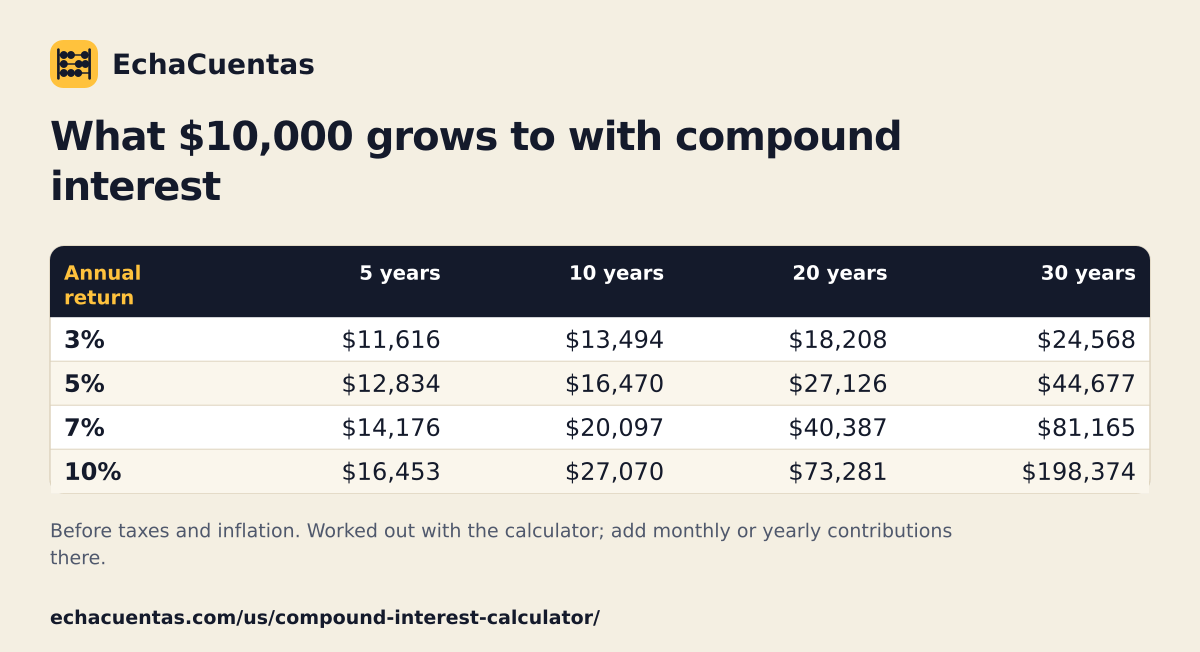 Save or share this table as an image
Common questions
Frequently asked questions
What is compound interest?
It is interest calculated on your balance plus the interest already earned, so interest earns more interest. This calculator compounds monthly.
How is it different from simple interest?
Simple interest is always calculated on the original amount; compound interest is calculated on a balance that keeps growing. Over one year the gap is small, but over 20 years it is large. Compare it with the simple interest calculator.
How long does it take to double my money?
Divide 72 by the annual rate of return: at 6% it takes about 12 years and at 3%, about 24. This is the rule of 72, an approximation the calculator shows for your rate.
What rate of return is realistic?
It depends on the product and the risk you take. A savings account usually pays much less than a stock index fund, which can also lose value in some years. Using a high, constant return is the most common mistake. This calculator is not financial advice.
Is the interest taxed?
It can be: interest and investment gains may be taxable unless they sit in a tax-advantaged account. The calculator does not subtract taxes or fees, so your real result may be lower. Check the terms of your account.
How does inflation affect the result?
It lowers what the money is really worth: with 4% annual inflation, $438,000 in 20 years is worth about $200,000 in today's dollars. Enter it under More options to see it with your numbers.
Saving and interest
News
Money
You may also need
Your next calculation
Missing a calculator?
Tell us what you need to calculate. The most requested ones are the first we build, with their formula, a worked example and the source.