Health and fitness
Due Date Calculator
When your baby might arrive and how far along you are
This due date calculator uses the first day of your last menstrual period. We tell you your estimated due date, how many weeks and days pregnant you are and which trimester you are in. It is an estimate: your doctor or midwife will confirm it.
| Milestone | Week | Date |
|---|---|---|
| Second trimester starts | 14 | December 3, 2026 |
| Third trimester starts | 28 | March 11, 2027 |
| Estimated due date | 40 | June 3, 2027 |
| 42 weeks: talk to your doctor | 42 | June 17, 2027 |
An estimate for adults. It is not a diagnosis and does not replace advice from your doctor or another health professional.
The key idea
Your due date is not a day: it is an estimate
The estimated due date comes from adding 280 days, or 40 weeks, to the first day of your last period. If your last period started on August 1, 2026, that gives May 8, 2027. Many babies arrive in the weeks before or after that day, and a first-trimester ultrasound dates the pregnancy more accurately than any calculator.
How it is calculated
Pregnancy is counted from the first day of your last menstrual period, not from conception, and lasts 280 days (40 weeks) on average.
Estimated due date = first day of last period + 280 days (Naegele's rule)
If your cycles are longer or shorter than 28 days, we shift the date by the difference. The due date is an estimate, and many babies arrive in the weeks before or after it.
According to ACOG, an ultrasound in the first trimester is the most accurate way to date a pregnancy. This calculator is an estimate and does not replace prenatal care: talk to your doctor or midwife.
If you know the date of conception or you conceived with IVF, choose it at the top: ACOG counts 266 days from conception, 261 days from a day-5 embryo transfer and 263 days from a day-3 transfer. The table shows when each trimester starts and the 42-week mark, when your doctor will want to see you if the baby has not arrived. An early ultrasound can change the date: your doctor will tell you which one to use.
Worked example
If your last period started on August 1, 2026, your estimated due date is May 8, 2027. On October 17, 2026, you would be 11 weeks pregnant.
Official sources
- ACOG Committee Opinion No. 700: Methods for Estimating the Due Date · due date from the last period, from IVF transfer (261 and 263 days) and by ultrasound
Typical cases
Due date chart by last period
Your estimated due date is 280 days (40 weeks) after the first day of your last menstrual period. Find the date closest to yours.
| First day of last period | Estimated due date |
|---|---|
| March 1, 2026 | December 6, 2026 |
| April 1, 2026 | January 6, 2027 |
| May 1, 2026 | February 5, 2027 |
| June 1, 2026 | March 8, 2027 |
| July 1, 2026 | April 7, 2027 |
| August 1, 2026 | May 8, 2027 |
| September 1, 2026 | June 8, 2027 |
| October 1, 2026 | July 8, 2027 |
| November 1, 2026 | August 8, 2027 |
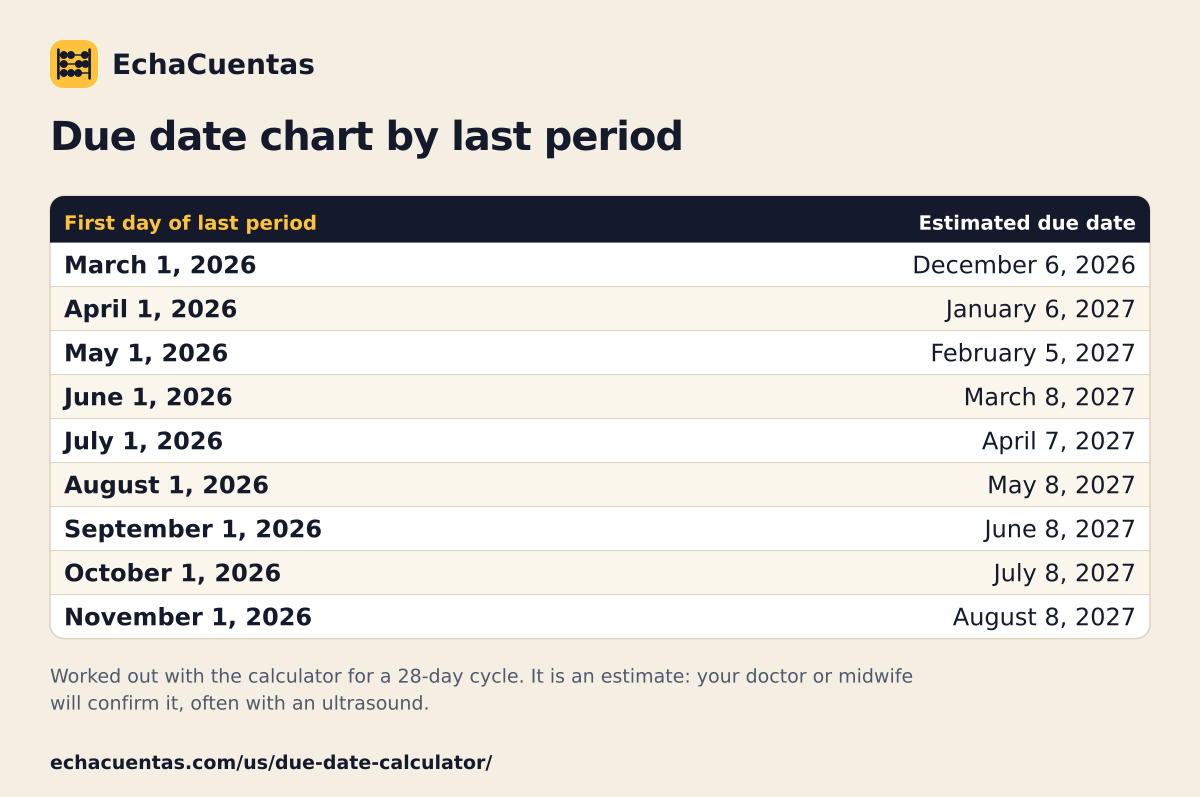 Save or share this table as an image
Common questions
Frequently asked questions
How are weeks of pregnancy counted?
From the first day of your last period, not from conception. That is why, in a 28-day cycle, conception happens about 2 weeks after that date. A pregnancy lasts 280 days on average, or 40 weeks.
How is the due date calculated?
By adding 280 days to the first day of your last period (Naegele's rule). If your cycles are longer or shorter than 28 days, the calculator shifts the date by the difference. A first-trimester ultrasound can correct it, and then the ultrasound date is the one that counts.
If my last period was August 1, 2026, when is my due date?
May 8, 2027, with a 28-day cycle. On October 17, 2026, you would be 11 weeks pregnant. With a 35-day cycle, the date moves back one week, to May 15, 2027.
When does each trimester start?
The first runs through week 13, the second from week 14 to 27 and the third from week 28 on. That is the split the calculator uses; some guides move the limits by a week.
What if I do not remember the date or my cycles are irregular?
Then counting from your period is not reliable, and the reference is your first ultrasound, which estimates gestational age by measuring the embryo. Use the calculator only as a rough guide until that visit.
Is it normal to give birth before or after the due date?
Yes, many babies are born in the weeks before or after it. The due date is an estimate, not an appointment. This calculator does not replace prenatal care: your doctor or midwife will tell you what to expect in your case.
Dates and deadlines
Your next calculation
Missing a calculator?
Tell us what you need to calculate. The most requested ones are the first we build, with their formula, a worked example and the source.