Money
401k Calculator
What your 401(k) can grow to with your contributions and the employer match
This 401k calculator projects your balance at retirement from your salary, the percentage you contribute, your employer match and the yearly return you choose, and checks your contribution against the 2026 IRS limit.
What if you saved more?
Your balance at retirement by the percentage of salary you contribute.
Move along the curve to see each case; tap to pick it.
The key idea
The employer match is not a bonus: it is part of your pay you lose if you do not contribute
Earning $60,000 and putting in 6% with a 50% match up to 6%, you save $3,600 a year and your employer adds $1,800. Over 30 years at a 6% return, that grows to about $440,000, and a third of it, about $147,000, comes from the match and its growth.
How it is calculated
Each year we add your contribution and your employer's match to the balance and grow it at the yearly return you set. Contributions are assumed to arrive evenly during the year, so they earn half a year of return in the year they are made.
Balance next year = balance × (1 + r) + (you + match) × (1 + r/2)
Your contribution is your salary times your percentage, capped at the 2026 IRS limit on elective deferrals: $24,500, plus a catch-up of $8,000 from age 50, or $11,250 at ages 60 to 63. We keep the 2026 limits for future years; in practice they are adjusted for inflation.
The match is the percentage your employer adds on your contribution, up to a share of your salary: «50% up to 6%» means that if you put in 6% or more, your employer adds 3% of your salary. Your plan's summary plan description has your exact formula and vesting schedule.
Traditional 401(k) money goes in before income tax and is taxed when you withdraw it; Roth 401(k) money goes in after tax. Withdrawals before 59½ usually carry a 10% additional tax. The result is a projection, not a guarantee.
Worked example
At 35, earning $60,000, contributing 6% ($3,600 a year) with a 50% match up to 6% ($1,800 a year), with a 6% return and no raises, you would have about $439,722 at 65. You put in $108,000, your employer $54,000, and growth adds $277,722.
Official sources
- IRS: 401(k) limit increases to $24,500 for 2026, IRA limit increases to $7,500 · 2026 limits: $24,500, catch-up $8,000 and $11,250, IRA $7,500
- IRS: Retirement topics, 401(k) and profit-sharing plan contribution limits
Typical cases
401(k) balance at 65 by starting age and salary
Estimated balance at 65 if you start from zero, contribute 6% of your salary with a 50% employer match on that 6%, and earn 6% a year, with no raises.
| Starting age | $50,000 salary | $75,000 salary | $100,000 salary |
|---|---|---|---|
| 25 | $717,322 | $1,075,983 | $1,434,643 |
| 30 | $516,500 | $774,750 | $1,033,000 |
| 35 | $366,435 | $549,652 | $732,869 |
| 40 | $254,297 | $381,446 | $508,594 |
| 45 | $170,501 | $255,752 | $341,002 |
| 50 | $107,884 | $161,826 | $215,768 |
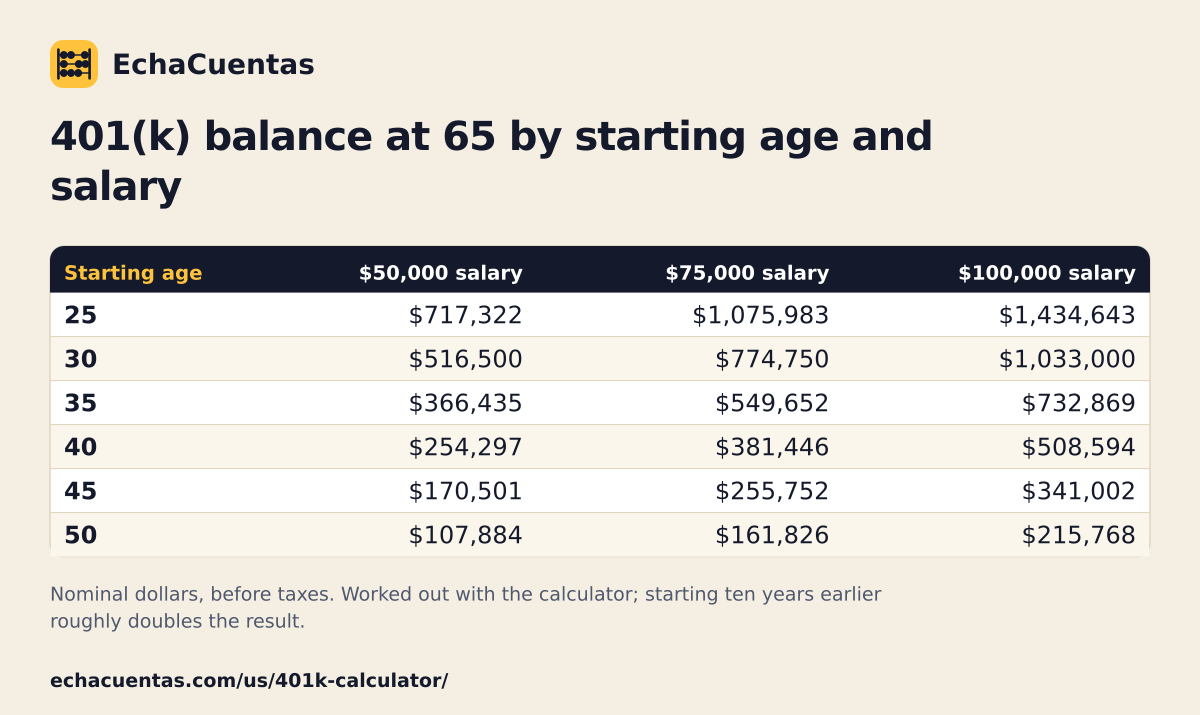 Save or share this table as an image
Common questions
Frequently asked questions
How much can I contribute to a 401(k) in 2026?
$24,500 of your own elective deferrals. From age 50 you can add a catch-up of $8,000, and at ages 60 to 63 the catch-up is $11,250, according to the IRS. Employer contributions are on top of that, under a higher overall limit.
How does an employer match work?
Your employer adds money based on what you contribute, up to a limit. With «50% up to 6%», contributing 6% of a $60,000 salary ($3,600) gets you $1,800 more a year; contributing only 3% gets you $900.
What return should I use?
Use a rate you are comfortable treating as a long-term average, and try a lower one too. Returns are not guaranteed and change year to year; a lower assumption shows a more cautious result.
Should I choose traditional or Roth 401(k)?
It depends on whether you expect a higher tax rate now or in retirement. Traditional contributions lower your taxable income today and are taxed when you withdraw; Roth contributions are taxed now and qualified withdrawals are tax-free.
What happens if I withdraw early?
Withdrawals before age 59½ are usually taxed as income and carry a 10% additional tax, unless an exception applies. Your plan may also offer loans or hardship withdrawals with their own rules.
How much is the IRA limit for 2026?
$7,500, plus a $1,100 catch-up from age 50. It is separate from the 401(k) limit, so you can contribute to both, although the tax deduction for a traditional IRA can be limited if you have a workplace plan.
Pay and taxes
News
Money
You may also need
Your next calculation
Missing a calculator?
Tell us what you need to calculate. The most requested ones are the first we build, with their formula, a worked example and the source.