Health and fitness
Target Heart Rate Calculator
Your heart rate for each training zone
This target heart rate calculator estimates your maximum heart rate and the beats per minute for each training zone from your age and your resting pulse. Take your pulse right after waking up so the result fits you better.
| Zone | Beats per minute |
|---|---|
| Zone 1 · Recovery | 124–136 |
| Zone 2 · Aerobic base | 136–149 |
| Zone 3 · Tempo | 149–162 |
| Zone 4 · Threshold | 162–174 |
| Zone 5 · Maximum | 174–187 |
An estimate for adults. It is not a diagnosis and does not replace advice from your doctor or another health professional.
The key idea
220 minus your age is not your max: it is a rough guess
The Tanaka formula (208 − 0.7 × age) fits better than the classic 220 − age, and the gap grows after 40. At 60, the classic formula gives 160 bpm and Tanaka gives 166. Even so, people of the same age vary a lot: only an exercise stress test measures your real maximum.
How it is calculated
Your maximum heart rate is estimated with the Tanaka formula, which fits adults better than the classic 220 − age:
Max HR = 208 − 0.7 × age
The zones use the Karvonen method, which takes your resting heart rate into account:
Target heart rate = resting + (max − resting) × % intensity
Zone 2 is the aerobic base (easy runs); zone 4 is threshold (intervals and race pace). An exercise stress test gives more reliable numbers. These are estimates: if you have a heart condition or take medication that affects your pulse, talk to your doctor before training hard.
Worked example
At 30 with a resting heart rate of 60: max HR = 208 − 21 = 187 bpm and a reserve of 127. Zone 2 (60-70%) runs from 136 to 149 beats per minute.
Typical cases
Heart rate zones by age
Estimated maximum heart rate and training zones by age, for a resting heart rate of 60 bpm. Measure yours and use the calculator for your own zones.
| Age | Max heart rate | Zone 2 · Aerobic base | Zone 3 · Tempo | Zone 4 · Threshold |
|---|---|---|---|---|
| 20 | 194 bpm | 140–154 | 154–167 | 167–181 |
| 25 | 191 bpm | 139–152 | 152–165 | 165–178 |
| 30 | 187 bpm | 136–149 | 149–162 | 162–174 |
| 35 | 184 bpm | 134–147 | 147–159 | 159–172 |
| 40 | 180 bpm | 132–144 | 144–156 | 156–168 |
| 45 | 177 bpm | 130–142 | 142–154 | 154–165 |
| 50 | 173 bpm | 128–139 | 139–150 | 150–162 |
| 55 | 170 bpm | 126–137 | 137–148 | 148–159 |
| 60 | 166 bpm | 124–134 | 134–145 | 145–155 |
| 65 | 163 bpm | 122–132 | 132–142 | 142–153 |
| 70 | 159 bpm | 119–129 | 129–139 | 139–149 |
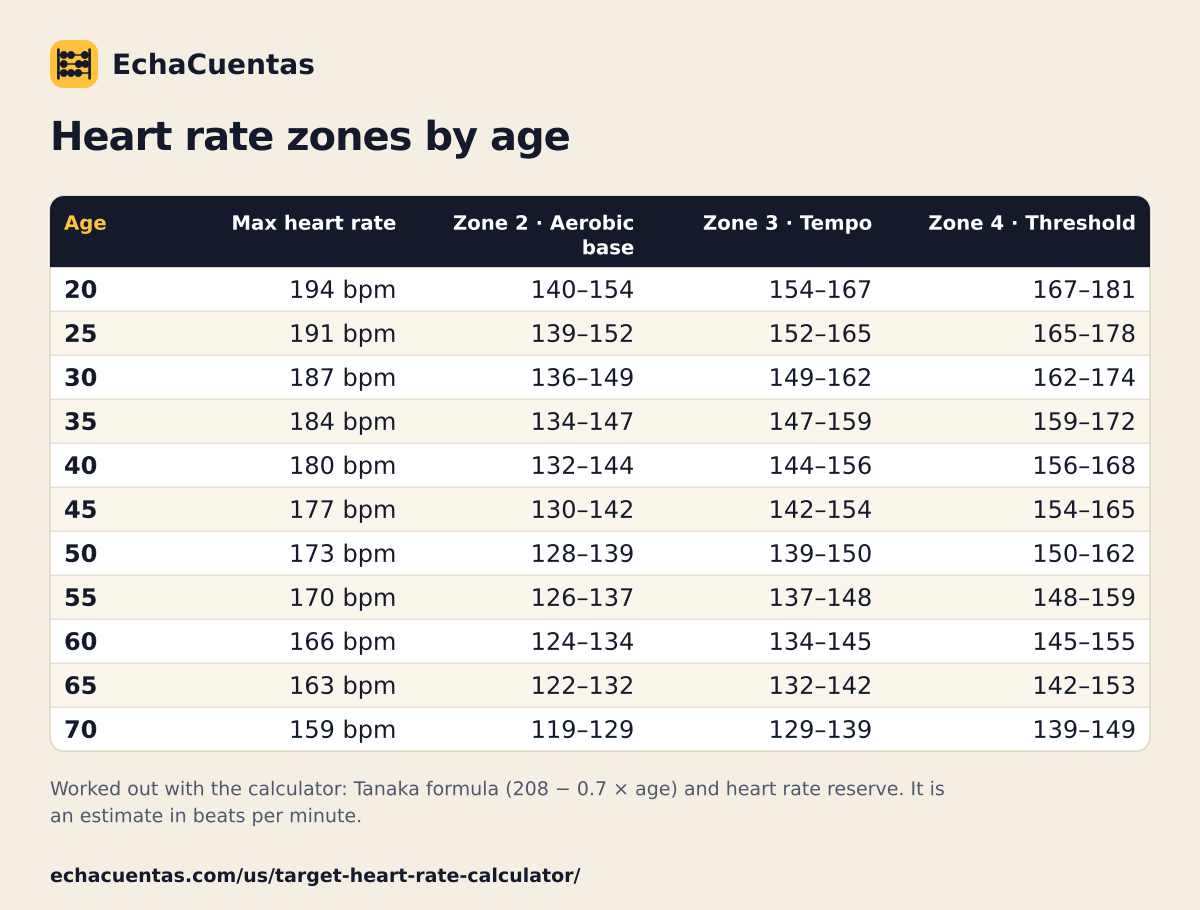 Save or share this table as an image
Common questions
Frequently asked questions
What is maximum heart rate?
It is the highest number of beats per minute your heart reaches during an all-out effort. It drops with age and varies a lot between people of the same age. Formulas estimate it; a stress test measures it.
What is the difference between Tanaka and 220 minus age?
Tanaka (208 − 0.7 × age) comes from a larger study and fits older adults better. At 40 both give 180 bpm; at 60, the classic formula gives 160 and Tanaka gives 166. The calculator shows you both.
What are my zones at 30 with a resting heart rate of 60?
Your estimated max is 187 bpm and your zone 2 runs from 136 to 149 beats per minute. It uses the Karvonen method: resting + (max − resting) × intensity. Zone 4, the threshold zone, runs from 162 to 174.
How do I measure my resting heart rate?
Right after waking up, lying down, for 60 seconds (or 15 seconds times 4). Average several days. If you measure it after coffee or after moving around, it comes out higher and shifts all your zones.
Is it dangerous to train in zone 5?
Not for a healthy person in short intervals. If you have not exercised in a while, have heart disease or take medication that affects your pulse, check with your doctor first. If you feel chest pain, dizziness or unusual shortness of breath, stop and get medical help.
What is each zone for?
Zone 1 is recovery; zone 2 is easy running that builds your aerobic base; zone 3 is steady tempo; zone 4 is threshold, for intervals and race pace; and zone 5 is for very short efforts. To know how fast you go in each session, use the pace calculator.
Your next calculation
Missing a calculator?
Tell us what you need to calculate. The most requested ones are the first we build, with their formula, a worked example and the source.