Work and taxes
Overtime Calculator
What your hours over 40 pay at time and a half
This overtime calculator applies the federal rule of the Fair Labor Standards Act: hours over 40 in a workweek are paid at least 1.5 times your regular rate. You see your overtime pay, your weekly gross and the premium part.
The key idea
Overtime is counted by the week, not by the day
Under federal law, working 10 hours on Monday is not overtime by itself; what counts is passing 40 hours in the workweek. At $20 an hour, a 50-hour week pays $800 for the first 40 hours and $300 for the other 10 at $30: $1,100 gross, of which $100 is the overtime premium.
How it is calculated
The Fair Labor Standards Act (29 U.S.C. § 207) requires covered, non-exempt employees to be paid at least one and one-half times their regular rate for every hour over 40 in a workweek. A workweek is a fixed period of 168 hours, seven days in a row, chosen by the employer.
Weekly pay = 40 × rate + (hours − 40) × rate × 1.5
The federal minimum wage is $7.25 an hour (29 U.S.C. § 206); many states and cities set a higher one. Exempt employees, such as many salaried managers and professionals, are not entitled to overtime under the FLSA.
Tax deduction for overtime (2025–2028): the federal deduction for qualified overtime compensation covers only the premium the FLSA requires, the extra half of the regular rate, not the whole overtime pay. It is limited to $12,500 a year ($25,000 joint) and is reduced by $100 for each $1,000 of income over $150,000 ($300,000 joint). Overtime pay is still subject to withholding, Social Security and Medicare.
Worked example
At $20 an hour, a 50-hour week is 40 regular hours ($800) and 10 overtime hours at $30 ($300): $1,100 gross. The premium above the regular rate is 10 × $10 = $100, which is the part that may qualify for the federal overtime deduction.
Official sources
- Fair Labor Standards Act, 29 U.S.C. § 207: maximum hours and overtime · overtime after 40 hours, 1.5× the regular rate
- Fair Labor Standards Act, 29 U.S.C. § 206: minimum wage · federal minimum wage
- 26 U.S.C. § 225: qualified overtime compensation deduction · qualified overtime compensation deduction
- IRS: One Big Beautiful Bill Act tax deductions for working Americans and seniors
Typical cases
Overtime pay chart: time and a half
Your overtime rate and your gross pay for the week at common hourly wages, when every hour over 40 is paid at 1.5 times.
| Hourly wage | Overtime rate | 45-hour week | 50-hour week | 60-hour week |
|---|---|---|---|---|
| $15.00 | $22.50 | $712.50 | $825.00 | $1,050.00 |
| $18.00 | $27.00 | $855.00 | $990.00 | $1,260.00 |
| $20.00 | $30.00 | $950.00 | $1,100.00 | $1,400.00 |
| $22.00 | $33.00 | $1,045.00 | $1,210.00 | $1,540.00 |
| $25.00 | $37.50 | $1,187.50 | $1,375.00 | $1,750.00 |
| $30.00 | $45.00 | $1,425.00 | $1,650.00 | $2,100.00 |
| $35.00 | $52.50 | $1,662.50 | $1,925.00 | $2,450.00 |
| $40.00 | $60.00 | $1,900.00 | $2,200.00 | $2,800.00 |
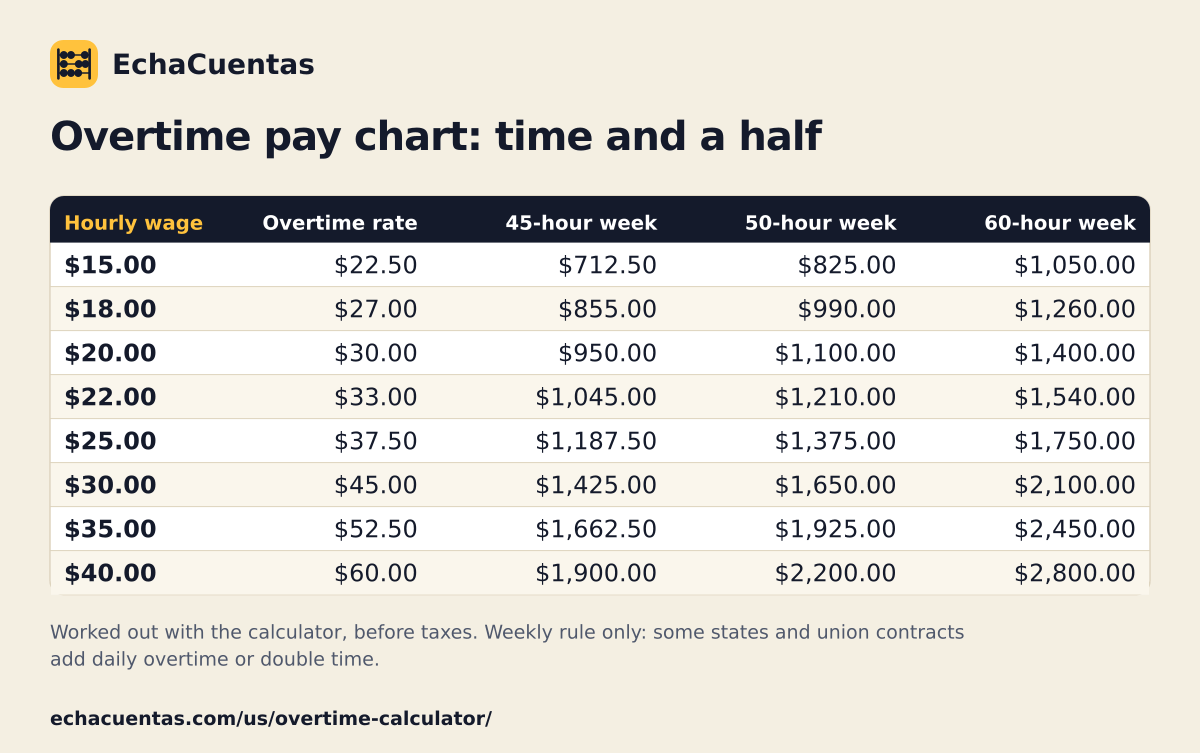 Save or share this table as an image
Common questions
Frequently asked questions
How is overtime calculated?
Multiply your regular hourly rate by 1.5 for each hour over 40 in the workweek. At $20 an hour, each overtime hour pays $30, so 10 hours of overtime add $300 to your 40 regular hours.
Is overtime paid after 8 hours a day?
Not under federal law: the FLSA counts hours over 40 in a workweek. Some states and many union contracts add daily overtime or double time, so check your state labor department or your contract.
Who is not entitled to overtime?
Exempt employees: mainly salaried executive, administrative and professional employees who meet the salary and duties tests, plus some other groups the FLSA lists. Being paid a salary alone does not make you exempt.
Is overtime tax-free now?
Not entirely. For 2025 through 2028 you can deduct the FLSA premium part of your overtime, the extra half of your rate, up to $12,500 a year ($25,000 joint), with a phase-out above $150,000 of income. Overtime is still withheld and still pays Social Security and Medicare.
What is the regular rate of pay?
It is your total pay for the workweek divided by the hours worked, and it can include bonuses and shift differentials, not just your hourly wage. If you earn extras, your overtime rate can be higher than 1.5 times your base wage.
Can my employer give me comp time instead of overtime pay?
Private employers generally must pay overtime in money under the FLSA. Compensatory time off instead of pay is allowed for public agencies under specific rules.
Hours, overtime and rates
News
Work and taxes
You may also need
Your next calculation
Missing a calculator?
Tell us what you need to calculate. The most requested ones are the first we build, with their formula, a worked example and the source.