Money
Loan Calculator
Your loan payment and what it really costs
Use this loan calculator to find the monthly payment on a personal, auto or student loan from the amount, the annual interest rate, the term in months and the origination fee.
The key idea
A longer loan is not cheaper: it costs more
$20,000 at 12% a year over 36 months comes to $664.29 a month and about $3,914 in interest. Over 60 months the payment drops to about $445, but the interest climbs to about $6,693. Paying less each month costs you nearly $2,800 more.
How it is calculated
Most fixed-rate personal and auto loans are fully amortizing: you pay the same amount every month.
Payment = P × i / (1 − (1 + i)^−n)
P is the loan amount, i the annual rate / 12 and n the number of months. An origination fee is charged up front and makes the loan more expensive. To compare offers, look at the APR, which adds certain fees to the interest rate.
The result does not include taxes, insurance or other charges: check your loan agreement.
Worked example
$20,000 over 36 months at 12% a year: payment ≈ $664.29/month. You pay about $23,914 in total, of which about $3,914 is interest.
Typical cases
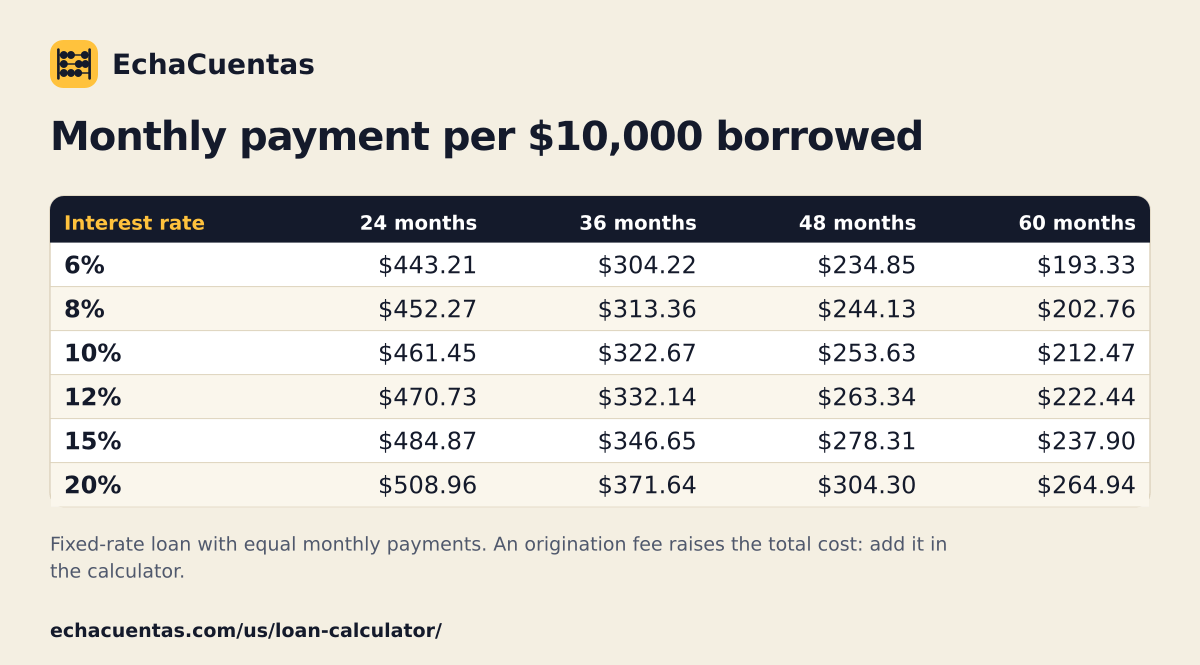
Monthly payment per $10,000 borrowed
The monthly payment on a $10,000 personal loan by APR and term, with no fees. For $20,000, double it.
| Interest rate | 24 months | 36 months | 48 months | 60 months |
|---|---|---|---|---|
| 6% | $443.21 | $304.22 | $234.85 | $193.33 |
| 8% | $452.27 | $313.36 | $244.13 | $202.76 |
| 10% | $461.45 | $322.67 | $253.63 | $212.47 |
| 12% | $470.73 | $332.14 | $263.34 | $222.44 |
| 15% | $484.87 | $346.65 | $278.31 | $237.90 |
| 20% | $508.96 | $371.64 | $304.30 | $264.94 |
 Save or share this table as an image
Common questions
Frequently asked questions
What is a personal loan?
It is a loan you repay in fixed monthly payments, usually without a house or a car as collateral. Because the lender relies on your income and credit, the rate is often higher than on a mortgage.
What is the difference between the interest rate and the APR?
The interest rate is what you are charged on the principal; the APR also includes certain fees, so it is the number to compare offers. This calculator uses the rate for the payment and adds the origination fee separately.
Is a shorter term or a lower payment better?
A shorter term costs less overall: you pay more each month but much less interest. With $20,000 at 12% a year, going from 60 to 36 months saves you about $2,779 in interest.
What mistakes are common when taking out a loan?
Looking only at the monthly payment. Check the APR, the origination fee and any add-on products the lender asks you to buy, because they all raise the final cost.
Can I pay off the loan early?
Usually yes, in full or in part, but the terms depend on your agreement. Before you do, ask whether there is a prepayment penalty and make sure the extra money goes to principal.
How much does a 2% origination fee cost?
On a $20,000 loan, $400 on top of the interest. At 12% a year over 36 months, the total cost goes from about $23,914 to about $24,314.
Mortgages, loans and debt
News
Money
You may also need
Auto Loan Calculator
Monthly car payment with tax, fees, trade-in and total interest.
CalculateSimple Interest Calculator
Interest on the original principal over days, months or years.
CalculateCredit Card Payoff Calculator
Months to pay off a card balance and total interest, or the payment you need.
CalculateYour next calculation
Missing a calculator?
Tell us what you need to calculate. The most requested ones are the first we build, with their formula, a worked example and the source.