Math
Quadratic Equation Calculator
Solve ax² + bx + c = 0 and understand what the discriminant tells you
Enter the coefficients a, b and c and this quadratic equation calculator solves it in seconds: discriminant, real or complex solutions and the vertex of the parabola.
The key idea
The discriminant is not just another step: it is the answer before you solve
With Δ = b² − 4ac you know how many real solutions there are before finishing the formula. In x² − 5x + 6 = 0, Δ = 25 − 24 = 1: it is positive, so there are two solutions, 3 and 2. In x² + 2x + 5 = 0, Δ = 4 − 20 = −16 and there is no real one: both are complex, −1 ± 2i.
How it is calculated
We use the quadratic formula:
x = (−b ± √(b² − 4ac)) / 2a
The discriminant Δ = b² − 4ac tells you how many solutions there are: if it is positive, two real ones; if it is zero, one repeated root; if it is negative, no real ones (two complex conjugates).
The vertex of the parabola is at x = −b / 2a.
Worked example
x² − 5x + 6 = 0: Δ = 25 − 24 = 1.
x = (5 ± 1) / 2 → x₁ = 3, x₂ = 2
Typical cases
Solved quadratic equations: examples
Common textbook equations and their solutions. The discriminant tells you which case you have: positive, two real roots; zero, one; negative, none.
| Equation | Discriminant | Solutions | Case |
|---|---|---|---|
| x² − 5x + 6 = 0 | 1 | 3, 2 | Two real solutions |
| x² − 4 = 0 | 16 | 2, -2 | Two real solutions |
| x² + 2x − 3 = 0 | 16 | 1, -3 | Two real solutions |
| x² − 7x + 12 = 0 | 1 | 4, 3 | Two real solutions |
| 2x² + 3x − 2 = 0 | 25 | 0.5, -2 | Two real solutions |
| x² − 2x − 1 = 0 | 8 | 2.4142, -0.4142 | Two real solutions |
| x² − 6x + 9 = 0 | 0 | 3 | One repeated solution |
| 4x² + 4x + 1 = 0 | 0 | -0.5 | One repeated solution |
| x² + x + 1 = 0 | -3 | -0.5 ± 0.866i | No real solutions (two complex ones) |
| x² + 4 = 0 | -16 | 0 ± 2i | No real solutions (two complex ones) |
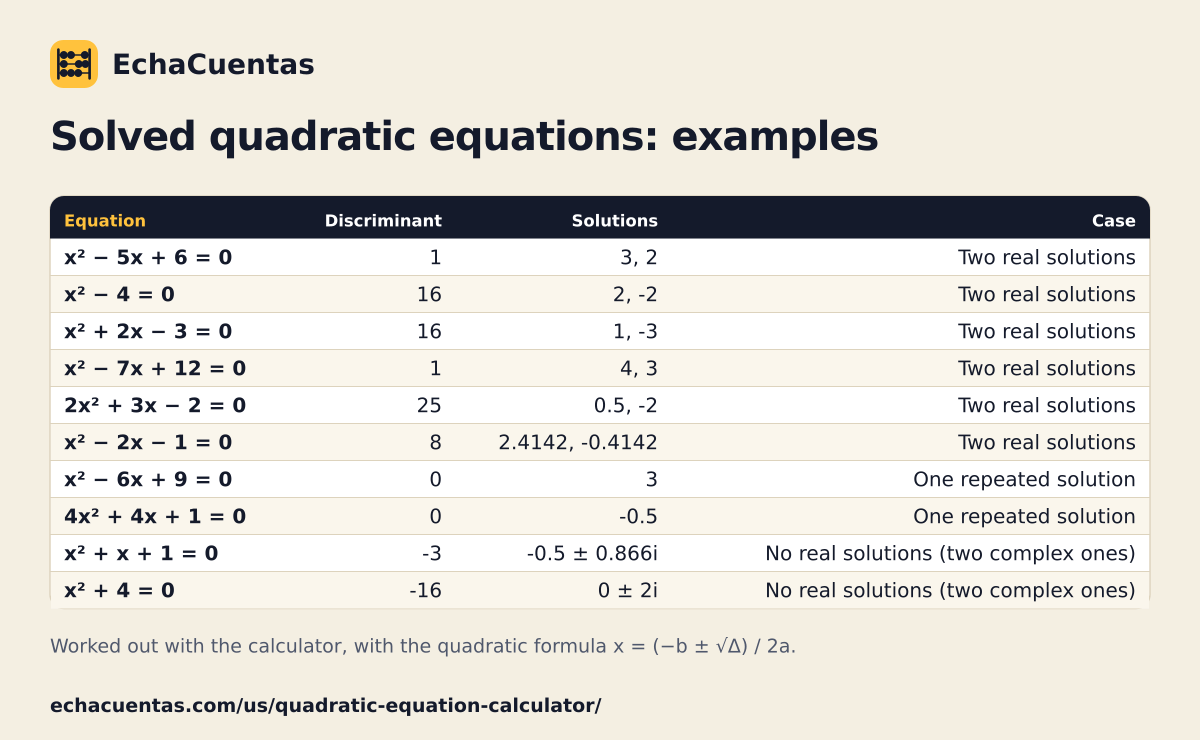 Save or share this table as an image
Common questions
Frequently asked questions
What if the b or c term is missing?
Enter 0 for that coefficient. For example, x² − 9 = 0 is a = 1, b = 0 and c = −9, with solutions 3 and −3.
What is an incomplete quadratic equation?
It is one where b = 0 or c = 0. You can solve it without the quadratic formula: if b = 0, isolate x²; if c = 0, factor out x, and one of the solutions is always 0.
What does a negative discriminant mean?
It means the equation has no real solutions: the parabola does not cross the x-axis. It has two complex conjugate solutions, which the calculator shows in the form p ± qi.
What happens if a = 0?
Then the equation is no longer quadratic but linear: bx + c = 0, with x = −c/b. The calculator detects it and gives you that solution.
What is the vertex used for?
The vertex is the lowest or highest point of the parabola y = ax² + bx + c. Its x-coordinate is −b/2a; if a is positive it is a minimum, and if a is negative, a maximum. For x² − 5x + 6, the vertex is (2.5, −0.25).
How do I check that the solutions are right?
Plug each solution into the equation: the result must be 0. You can also use x₁ + x₂ = −b/a and x₁ · x₂ = c/a: in x² − 5x + 6 = 0, 3 + 2 = 5 and 3 · 2 = 6.
Equations, statistics and probability
Math
You may also need
Your next calculation
Missing a calculator?
Tell us what you need to calculate. The most requested ones are the first we build, with their formula, a worked example and the source.