Work and taxes
Self-Employment Tax Calculator
The Social Security and Medicare you pay as your own boss
This self-employment tax calculator figures the Social Security and Medicare tax you owe on your freelance or business profit for 2026, the way Schedule SE does, plus the half you can deduct from your income.
The key idea
Self-employment tax is not income tax: you pay it even if you owe no income tax
As an employee you pay 7.65% and your employer pays the other 7.65%. Working for yourself, you pay both halves: 15.3% on 92.35% of your profit. On $50,000 of profit that is $7,064.78, before any income tax, and you can deduct half of it, $3,532.39, from your income.
How it is calculated
If you work for yourself, you pay both the employee and the employer share of Social Security and Medicare, through Schedule SE:
- Net earnings: 92.35% of your net profit. The 7.65% you leave out stands in for the employer half that an employer could deduct.
- Social Security: 12.4% of net earnings, up to the 2026 wage base of $184,500. W-2 wages from a job count first toward that limit.
- Medicare: 2.9% of all your net earnings, with no limit. Above $200,000 ($250,000 joint, $125,000 separate), there is an Additional Medicare Tax of 0.9%, reported on Form 8959.
SE tax = 92.35% × profit × 12.4% (up to the wage base) + 92.35% × profit × 2.9%
You owe no self-employment tax if your net earnings are under $400. You can deduct half of the tax (without the Additional Medicare Tax) when you figure your adjusted gross income. Self-employment tax is separate from income tax: it goes on top of it, and both are usually paid during the year through estimated tax payments.
Worked example
With $50,000 of net profit and no other job, net earnings are $50,000 × 92.35% = $46,175. Social Security: 12.4% = $5,725.70. Medicare: 2.9% = $1,339.08. Self-employment tax: $7,064.78, an effective 14.13% of profit. Half of it, $3,532.39, is deductible from your income.
Official sources
- IRS Topic No. 554: Self-Employment Tax · rates, 92.35% and the deductible half
- IRS Publication 15 (2026): Employer's Tax Guide · 2026 Social Security wage base
- IRS Topic No. 560: Additional Medicare Tax · Additional Medicare Tax thresholds
Typical cases
Self-employment tax for 2026 by net profit
The Social Security and Medicare tax you pay on common net profits as a sole proprietor, filing single, with no W-2 wages.
| Net profit | Self-employment tax | Deductible half | Effective rate |
|---|---|---|---|
| $10,000 | $1,412.96 | $706.48 | 14.13% |
| $20,000 | $2,825.91 | $1,412.96 | 14.13% |
| $30,000 | $4,238.87 | $2,119.43 | 14.13% |
| $40,000 | $5,651.82 | $2,825.91 | 14.13% |
| $50,000 | $7,064.78 | $3,532.39 | 14.13% |
| $60,000 | $8,477.73 | $4,238.87 | 14.13% |
| $75,000 | $10,597.16 | $5,298.58 | 14.13% |
| $100,000 | $14,129.55 | $7,064.78 | 14.13% |
| $125,000 | $17,661.94 | $8,830.97 | 14.13% |
| $150,000 | $21,194.32 | $10,597.16 | 14.13% |
| $200,000 | $28,234.30 | $14,117.15 | 14.12% |
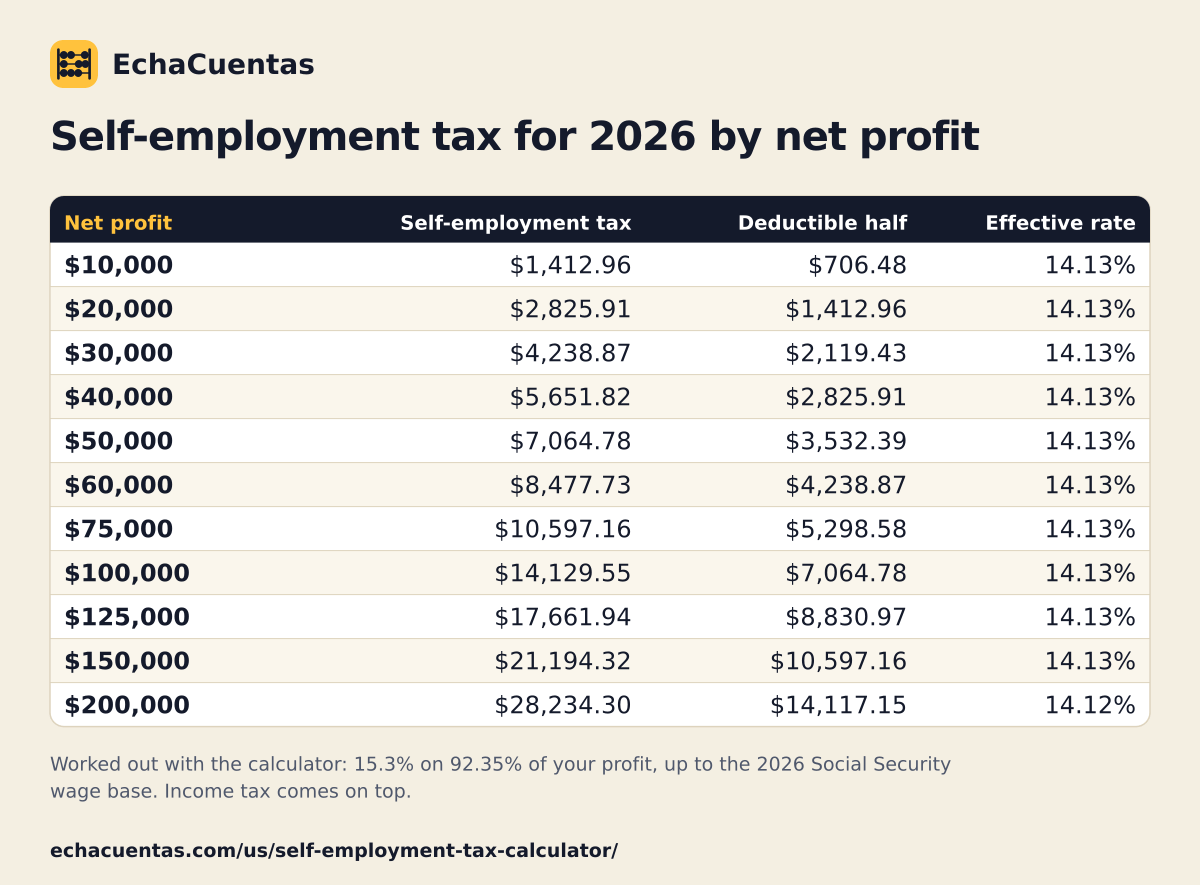 Save or share this table as an image
Common questions
Frequently asked questions
What is the self-employment tax rate for 2026?
15.3%: 12.4% for Social Security and 2.9% for Medicare, applied to 92.35% of your net profit. The Social Security part stops at $184,500 of earnings in 2026; the Medicare part has no limit.
Do I have to pay self-employment tax?
Yes, if your net earnings from self-employment are $400 or more. It applies even if you owe no income tax and even if you already receive Social Security benefits.
Why is it calculated on 92.35% of profit?
Because the law lets you leave out the equivalent of the employer half of the tax, 7.65%, before applying the rate. That puts you on a similar footing to an employee, whose employer pays and deducts its own share.
Can I deduct self-employment tax?
Yes, half of it. You subtract it when figuring your adjusted gross income, so it lowers your income tax, although it does not lower the self-employment tax itself.
I also have a job. Does that change my self-employment tax?
It can. Your W-2 wages count first toward the $184,500 Social Security wage base, so if your wages and profit together pass it, you pay the 12.4% only on the part of your profit below the limit. Type your wages to see it.
Is self-employment tax the same as quarterly estimated tax?
No. Estimated tax is how you pay during the year; self-employment tax is one of the taxes you pay with it, together with your income tax. The calculator gives the self-employment part for the whole year.
Pay and taxes
News
Work and taxes
You may also need
Federal Income Tax Calculator 2026
2026 federal tax, effective and marginal rate, refund or balance due.
CalculateFreelance Rate Calculator
The hourly rate you need to charge as a freelancer.
CalculateSocial Security Benefits Calculator
Your monthly retirement benefit at 62, full retirement age and 70.
CalculateYour next calculation
Missing a calculator?
Tell us what you need to calculate. The most requested ones are the first we build, with their formula, a worked example and the source.