Health and fitness
Calorie Calculator
How many calories you need a day for your activity level
With this calorie calculator you estimate your resting metabolic rate and what you burn in a day based on your activity. We give you an estimate to maintain, lose or gain weight, in pounds and feet or in metric.
An estimate for adults. It is not a diagnosis and does not replace advice from your doctor or another health professional.
The key idea
Your calories are not a fixed number: they are an estimate you adjust
The Mifflin-St Jeor equation estimates what you burn at rest, and the activity factor multiplies it by 1.2 to 1.9. A 30-year-old man who weighs 154 lb and is 5 ft 9 in burns about 1,649 calories at rest and about 2,556 with moderate activity. Real needs can differ from any estimate, so adjust based on how your weight actually changes.
How it is calculated
First we estimate your resting metabolic rate (what you burn at rest) with the Mifflin-St Jeor equation, using weight in kilograms, height in centimeters and age in years. Pounds and inches are converted first.
Men: 10 × weight + 6.25 × height − 5 × age + 5
Women: 10 × weight + 6.25 × height − 5 × age − 161
Then we multiply it by an activity factor (from 1.2 if you are sedentary to 1.9 if you train hard every day) to get your maintenance calories.
To lose weight we subtract a moderate deficit of 500 calories (never going below your resting rate), and to gain weight we add 300.
It is an estimate for healthy adults. Before starting a diet, or if you have a health condition, talk to your doctor or a registered dietitian.
Worked example
A 30-year-old man, 154 lb (69.9 kg) and 5 ft 9 in (175.3 cm): resting rate = 698.5 + 1,095.4 − 150 + 5 = 1,649 calories. With moderate activity (× 1.55) he needs about 2,556 calories a day to maintain his weight.
Typical cases
Calories a day to maintain your weight
Estimated maintenance calories by activity level for a woman 5 ft 4 in and 140 lb and a man 5 ft 10 in and 180 lb, at 25 and 50.
| Activity | Woman, 25 | Woman, 50 | Man, 25 | Man, 50 |
|---|---|---|---|---|
| Sedentary | 1,638 cal | 1,488 cal | 2,169 cal | 2,019 cal |
| Light (1-3 days a week) | 1,877 cal | 1,705 cal | 2,486 cal | 2,314 cal |
| Moderate (3-5 days a week) | 2,116 cal | 1,922 cal | 2,802 cal | 2,608 cal |
| High (6-7 days a week) | 2,355 cal | 2,139 cal | 3,118 cal | 2,903 cal |
| Very high | 2,594 cal | 2,356 cal | 3,435 cal | 3,197 cal |
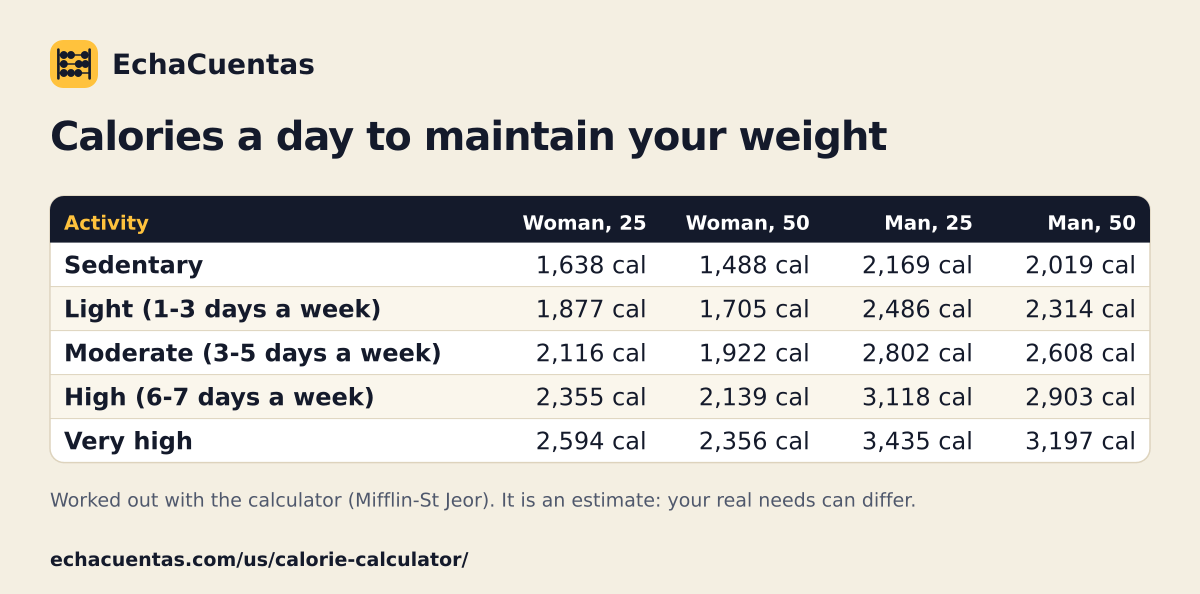 Save or share this table as an image
Common questions
Frequently asked questions
What is resting metabolic rate?
It is the energy your body burns at rest just to keep running: breathing, pumping blood and holding your temperature. It is usually the largest part of what you burn in a day. The calculator estimates it with the Mifflin-St Jeor equation and then multiplies it by your activity level.
How do you calculate the calories I need?
You multiply your resting metabolic rate by an activity factor: 1.2 if you are sedentary, 1.55 with moderate activity and up to 1.9 if you train a lot. The result is your maintenance calories. To lose weight we subtract 500, never going below your resting rate, and to gain weight we add 300.
How many calories does a 30-year-old woman need?
About 2,045 calories a day if she weighs 132 lb, is 5 ft 5 in and has moderate activity. Her resting rate is about 1,320 calories, and the 1.55 factor brings it to maintenance. A different weight, height or activity level changes the number, so run it with your own data.
What is the most common mistake?
Overstating your activity: picking high when you work out three days a week inflates the result by almost 300 calories. For 3-5 days of exercise, the right level is moderate. It is also not a good idea to eat below your resting rate without medical supervision.
How much weight do you lose by eating 500 fewer calories a day?
It adds up to a deficit of 3,500 calories a week, but the weight you actually lose varies from person to person. Over time your body adapts and the pace usually slows. Run the numbers again when your weight changes.
Is the result exact?
No, it is an estimate: your real needs can be higher or lower. A good check is to track your weight for a few weeks and adjust. If you have a medical condition, are pregnant or want to follow a strict diet, talk to your doctor or a registered dietitian.
Health and fitness
Your next calculation
Missing a calculator?
Tell us what you need to calculate. The most requested ones are the first we build, with their formula, a worked example and the source.