Math
Permutation and Combination Calculator
How many ways there are to choose, with or without order
This permutation and combination calculator tells you how many groups you can make from n items taken r at a time: combinations, permutations and arrangements, with and without repetition.
With repetition: combinations 220 · permutations 1,000Formula explained below · reviewed October 17, 2026
The key idea
Choosing is not ordering: order multiplies the possibilities
Picking 3 people out of 10 for a committee gives 120 possible groups. If the 3 seats are different (president, secretary and treasurer), there are 720, six times more, because each group can be ordered in 3! = 6 ways. The first question is always whether order matters.
How it is calculated
- Does order matter? Yes → permutations. No → combinations.
- Do you use all the items? Yes → arrangements of all n, n!. No → permutations P(n, r) or combinations C(n, r).
C(n, r) = n! / (r! (n − r)!) P(n, r) = n! / (n − r)! P(n, n) = n!
With repetition: (n + r − 1)! / (r! (n − 1)!) combinations nʳ permutations
Worked example
From 10 people you choose 3 for a committee (order does not matter): C(10, 3) = 120. If they are president, secretary and treasurer (order matters): P(10, 3) = 720.
Typical cases
Combinations chart: n choose r
How many ways you can choose r items out of n when order does not matter and nothing repeats, like 10 choose 3.
| n | Choose 2 | Choose 3 | Choose 4 | Choose 5 |
|---|---|---|---|---|
| 10 | 45 | 120 | 210 | 252 |
| 11 | 55 | 165 | 330 | 462 |
| 12 | 66 | 220 | 495 | 792 |
| 13 | 78 | 286 | 715 | 1,287 |
| 14 | 91 | 364 | 1,001 | 2,002 |
| 15 | 105 | 455 | 1,365 | 3,003 |
| 16 | 120 | 560 | 1,820 | 4,368 |
| 18 | 153 | 816 | 3,060 | 8,568 |
| 20 | 190 | 1,140 | 4,845 | 15,504 |
| 25 | 300 | 2,300 | 12,650 | 53,130 |
| 30 | 435 | 4,060 | 27,405 | 142,506 |
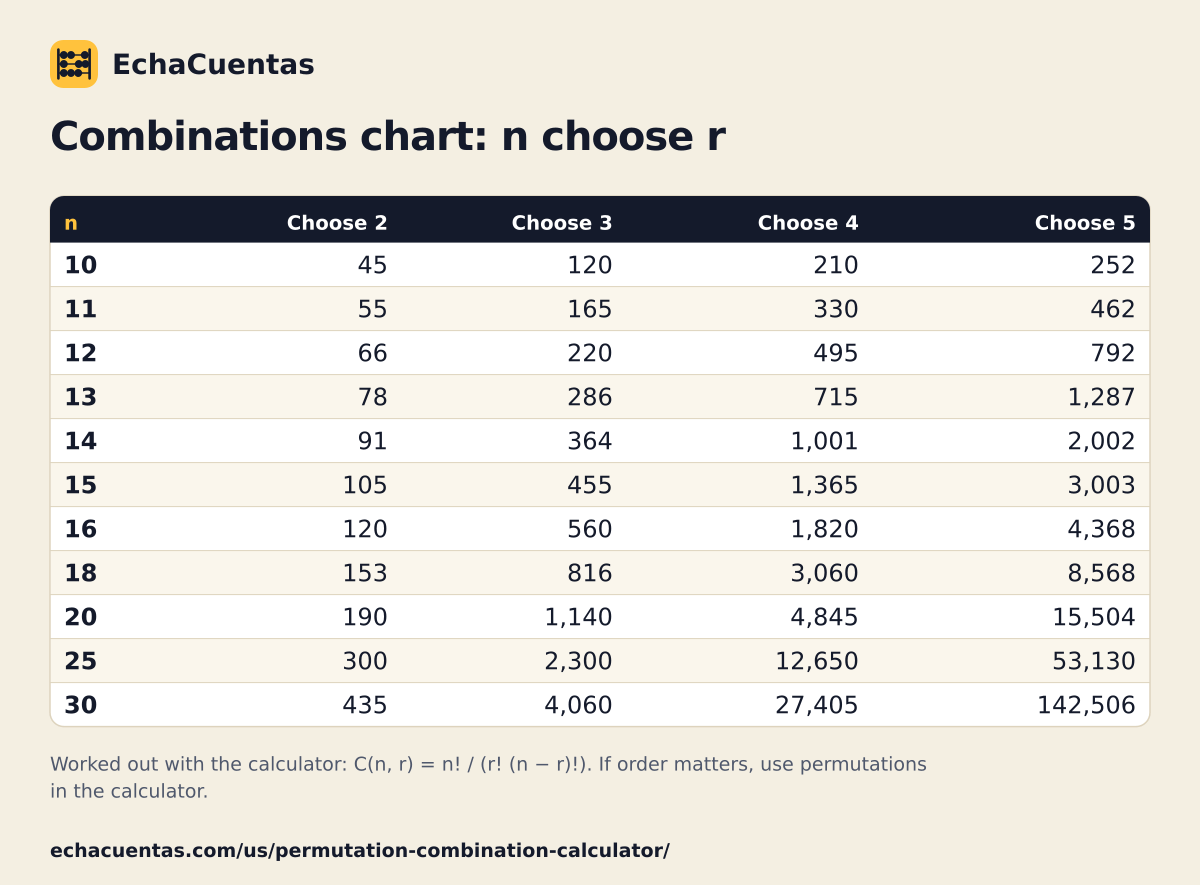 Save or share this table as an image
Common questions
Frequently asked questions
How many combinations are there when you choose 6 numbers out of 56?
32,468,436: you pick 6 numbers out of 56 and order does not matter, which is C(56, 6). It is the kind of count behind a lottery draw where you pick 6 numbers; if the game adds a bonus number, the possibilities grow.
How many 4-digit codes are there?
10,000: order matters and digits can repeat, so they are permutations with repetition, 10⁴. They run from 0000 to 9999.
What is the difference between combinations and permutations?
In permutations order matters and in combinations it does not. AB and BA are two different permutations but a single combination. People also write them as nPr and nCr.
How many ways can you arrange n items?
n! ways (n factorial): with 5 books on a shelf there are 5! = 120 possible orders. It is the permutation of all the items, P(n, n).
What does with repetition mean?
It means the same item can be chosen more than once. With 3 ice cream flavors and 2 scoops, there are 6 combinations if you can repeat a flavor and 3 if you cannot.
Why can n not be larger than 170?
Because 171! is larger than the biggest number the browser can handle, about 1.8 × 10³⁰⁸. Very large results are shown in scientific notation.
Equations, statistics and probability
Math
You may also need
Your next calculation
Missing a calculator?
Tell us what you need to calculate. The most requested ones are the first we build, with their formula, a worked example and the source.