Work and taxes
Paycheck Calculator
Your take-home pay after federal tax, Social Security and Medicare
This paycheck calculator turns your gross pay into what lands in your bank account: federal income tax withholding with the 2026 IRS tables, Social Security, Medicare, your pre-tax deductions and an optional state rate.
What if you earned more?
Take-home pay per paycheck by yearly salary, with the rest of your details.
Move along the curve to see each case; tap to pick it.
The key idea
Your salary is not your paycheck: withholding takes its share first
On a $60,000 salary paid every two weeks, each paycheck is $2,307.69 gross. Federal withholding takes $193.08, Social Security $143.08 and Medicare $33.46, so you take home about $1,938.08 before any state tax: 84% of gross.
How it is calculated
Your employer takes three things out of every paycheck by law, plus whatever you choose to save before tax:
- Federal income tax withholding. We use the 2026 annual percentage method of IRS Publication 15-T (Worksheet 1A) with the answers on your Form W-4: your pay is annualized, the employer adjustment of $8,600 ($12,900 if married filing jointly) is subtracted when the Step 2 box is not checked, the withholding table gives the yearly amount and it is divided by your number of paychecks.
- Social Security: 6.2% of your wages up to $184,500 in 2026.
- Medicare: 1.4500000000000002% of all your wages, plus an Additional Medicare Tax of 0.8999999999999999% that your employer withholds on wages over $200,000 in the year.
Take-home = Gross − federal withholding − Social Security − Medicare − state tax − pre-tax deductions
Traditional 401(k) deferrals lower the wages subject to income tax but not to Social Security and Medicare. Section 125 deductions, such as most employer health plans, lower both. When your pay is steady, we spread the Social Security wage base and the Additional Medicare threshold evenly across the year; a real payroll applies them on the paycheck where you cross them.
The other way around: choose «The salary I need for a take-home pay» and type what you want to receive per paycheck. We find the gross pay that leaves exactly that amount after the same withholding, Social Security and Medicare, which helps when you negotiate an offer.
Withholding is a prepayment, not your final tax: your actual tax is settled on your return. The state rate is a flat estimate you type; for an exact state figure, check your state's withholding tables.
Worked example
A $60,000 salary paid every two weeks is $2,307.69 per paycheck. Annualized, that is $60,000; minus the $8,600 adjustment for a single filer, $51,400. The 2026 table gives $1,240 plus 12% of the amount over $19,900: $5,020 a year, or $193.08 per paycheck. Social Security is $143.08 and Medicare $33.46. Take-home pay: $1,938.08 per paycheck, $50,390 a year, before any state tax.
Official sources
- IRS Publication 15-T (2026): Federal Income Tax Withholding Methods · Worksheet 1A and 2026 annual percentage method tables
- IRS Publication 15 (2026): Employer's Tax Guide · 2026 Social Security wage base
- IRS Topic No. 751: Social Security and Medicare Withholding Rates
- IRS Topic No. 560: Additional Medicare Tax
- IRS: About Form W-4, Employee’s Withholding Certificate
Typical cases
Salary after taxes chart for 2026
Take-home pay for common salaries, filing single, paid every two weeks, with no state income tax or pre-tax deductions. Tap a salary for its full breakdown.
| Salary | Take-home per year | Per month | Every two weeks |
|---|---|---|---|
| $30,000 | $26,285.00 | $2,190 | $1,010.96 |
| $40,000 | $34,320.00 | $2,860 | $1,320.00 |
| $45,000 | $38,337.50 | $3,195 | $1,474.52 |
| $50,000 | $42,355.00 | $3,530 | $1,629.04 |
| $55,000 | $46,372.50 | $3,864 | $1,783.56 |
| $60,000 | $50,390.00 | $4,199 | $1,938.08 |
| $65,000 | $54,407.50 | $4,534 | $2,092.60 |
| $70,000 | $58,075.00 | $4,840 | $2,233.65 |
| $75,000 | $61,592.50 | $5,133 | $2,368.94 |
| $80,000 | $65,110.00 | $5,426 | $2,504.23 |
| $90,000 | $72,145.00 | $6,012 | $2,774.81 |
| $100,000 | $79,180.00 | $6,598 | $3,045.38 |
| $120,000 | $93,250.00 | $7,771 | $3,586.54 |
| $150,000 | $113,791.00 | $9,483 | $4,376.58 |
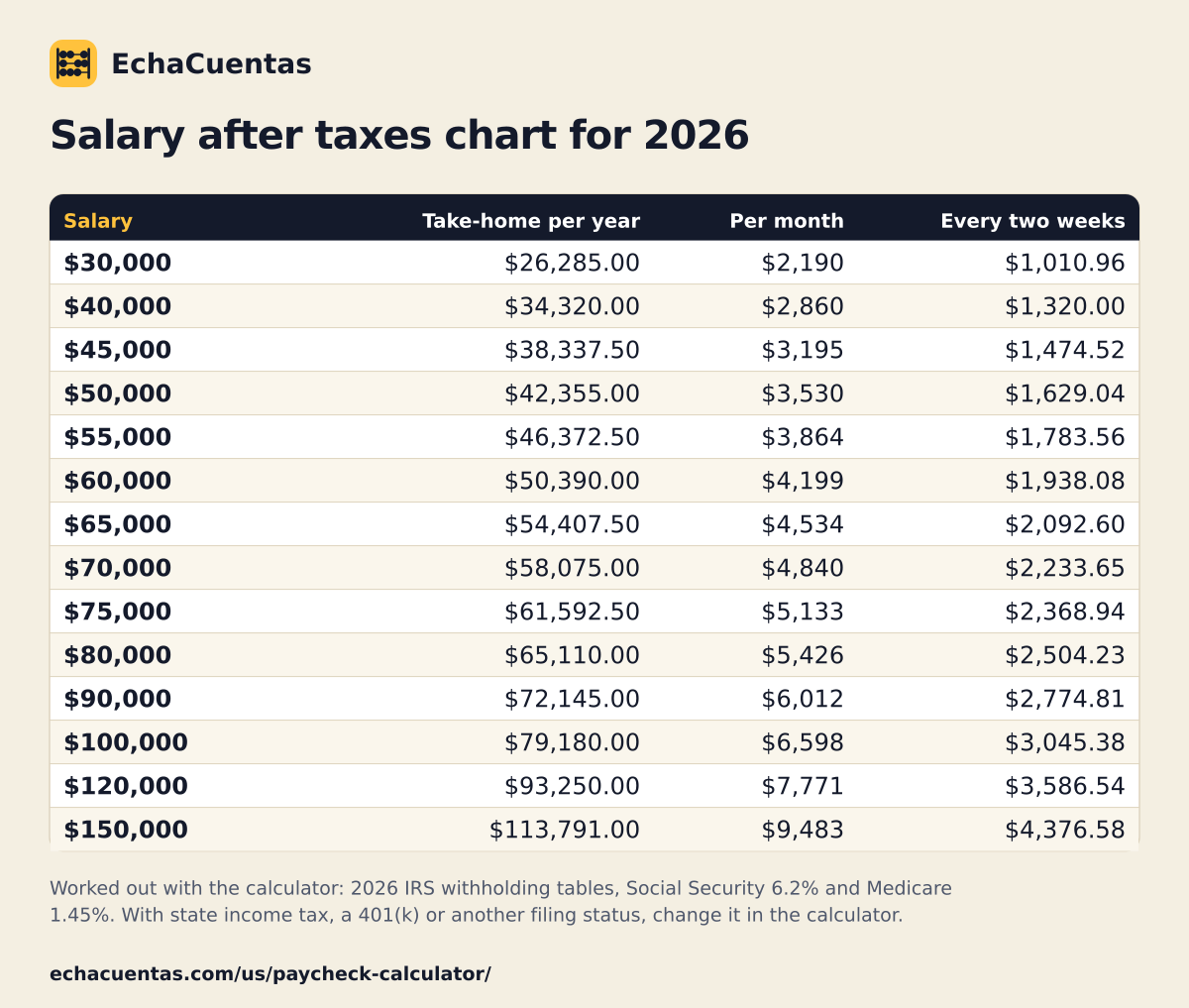 Save or share this table as an image
Common questions
Frequently asked questions
How much federal tax comes out of my paycheck?
It depends on your pay, how often you are paid and your Form W-4. A single filer earning $60,000 a year, paid every two weeks, has about $193.08 withheld per paycheck in 2026 with the IRS Publication 15-T tables.
What percentage of my paycheck goes to Social Security and Medicare?
7.65% in total: 6.2% for Social Security and 1.45% for Medicare. Social Security stops once your wages for the year pass $184,500 in 2026, and an extra 0.9% of Medicare tax is withheld on wages over $200,000.
Does my 401(k) lower my taxes?
Yes, a traditional 401(k) lowers the wages your federal income tax withholding is based on. It does not lower Social Security and Medicare, which are still figured on your full pay. A Roth 401(k) is taken after tax.
What does the Step 2 checkbox on the W-4 do?
It tells your employer to withhold at a higher rate because you have two jobs or both spouses work. Checking it switches to the Step 2 tables in Publication 15-T and removes the standard adjustment, so more is withheld from each paycheck.
Why is my refund or balance due different from my withholding?
Because withholding is an estimate made paycheck by paycheck. Your real tax is figured on your return with all your income, deductions and credits; if more was withheld than you owe, you get a refund.
Does this include state income tax?
Only as a flat rate you type. States set their own rules: some do not tax wages and others use brackets or local taxes. Leave it at 0 to see your federal take-home pay, or type your effective state rate.
Pay and taxes
News
Work and taxes
You may also need
Federal Income Tax Calculator 2026
2026 federal tax, effective and marginal rate, refund or balance due.
CalculateHourly to Salary Calculator
Hourly wage to annual, monthly and weekly pay, and back.
Calculate401k Calculator
Retirement balance with your contributions, the match and 2026 limits.
CalculateYour next calculation
Missing a calculator?
Tell us what you need to calculate. The most requested ones are the first we build, with their formula, a worked example and the source.